
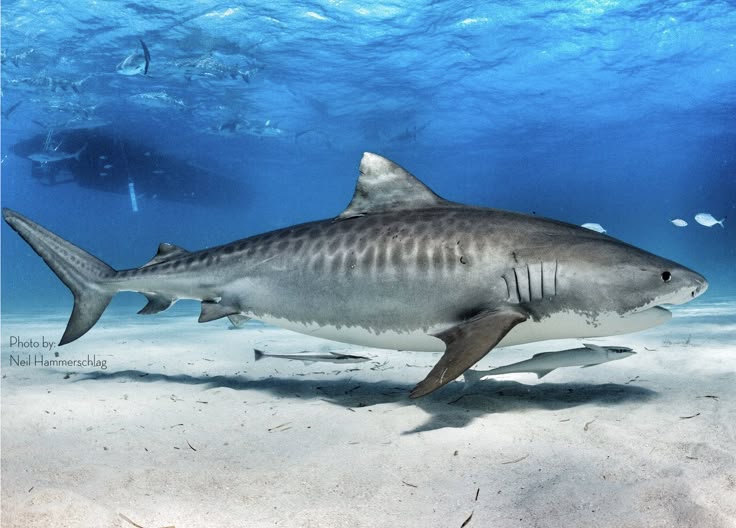
Sharks are marine mammals that belong to the phylum Chordata, which is characterized by animals that have a backbone, a spinal column, and a notochord. Sharks are then further organized into the class Chondrichthyes, which includes all fish with skeletons made of cartilage, and then into the subclass Elasmobranchii, which includes sharks, rays, and skates.
Sharks can come in many shapes and sizes, some live in saltwater, some in brackish, and some in freshwater. The main characteristics most sharks have in common are their cartilaginous skeletons, which are less dense than those of fish that have bone skeletons; this is what makes all sharks fast and flexible animals. Dermal Denticles are another thing all sharks have in common; Dermal Denticles are small tooth-like scales that cover a shark’s skin. This helps them reduce hydrodynamic resistance and protects the sharks against cuts and parasites. And of course, how could I forget about a shark’s most notable feature, their constantly renewing teeth. Sharks cycle through rows and rows of teeth; if a tooth gets torn out, a new one is already ready to take its place. This helps the shark to not only be able to continue feeding itself, but also to continue to protect itself from other predators.